Live satellites over Australia’s launch sites.

From the space precinct on North Terrace to launch pads in Arnhem Land and north Queensland, every place below is a real site under real orbits. Pick one: the film reframes and works out what flies over it today.


Next over Lot Fourteen: Computing… · Kanyini

Computed from today’s orbital elements from CelesTrak. Drag the globe, scroll or pinch to zoom.

Place

Satellite

More satellites

View

About Kanyini

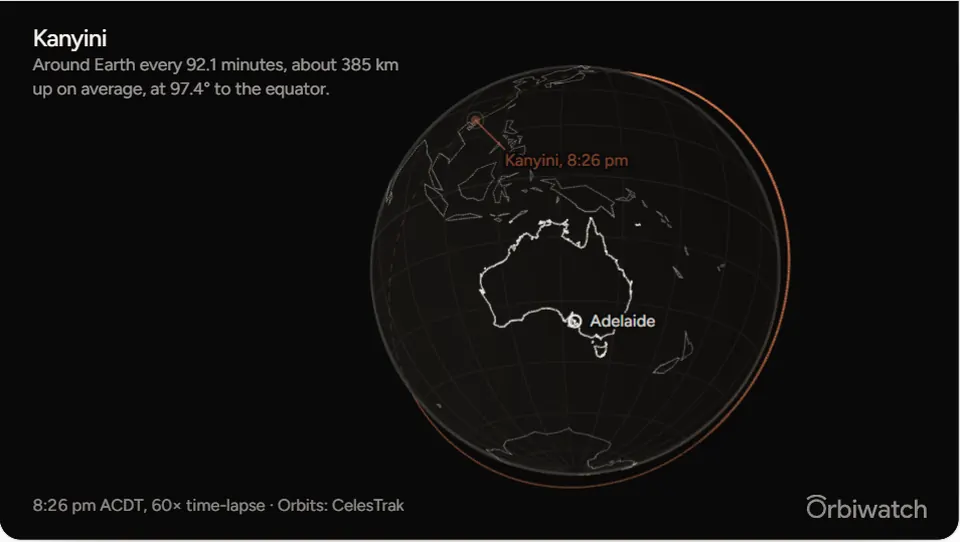
South Australia’s own satellite, launched to test an Internet of Things service and hyperspectral Earth imaging. Its payloads lost contact in mid 2025; the spacecraft is still in orbit.

  • Designed and built in South Australia: Inovor Technologies built the spacecraft at Lot Fourteen for the Government of South Australia.
  • Its name is a Pitjantjatjara word for responsibility and unconditional love for all of creation, chosen by Year 11 students at Findon High School.
  • Since a fault in mid 2025 cut the link to its payloads, its other systems keep running and engineers still receive its telemetry.

The space precinct

Lot Fourteen, home of the Australian Space Agency

Lot Fourteen, on Adelaide’s North Terrace, is home to the Australian Space Agency, the Australian Space Discovery Centre and a cluster of space companies, a few minutes’ walk from the CBD.
Kanyini, South Australia’s first state-funded satellite, was built here by Inovor Technologies and launched in August 2024. Its two payloads lost contact in mid 2025; the spacecraft itself is still in orbit, and the film tracks it from today’s elements.

Satellite
Kanyini, 6U CubeSat
Launched
17 August 2024, Adelaide time
Orbit
Sun-synchronous, low and descending

Satellites over eight Australian space sites.

Adelaide, SA. Satellite: Kanyini, 6U CubeSat.

  • The Australian Space Agency’s headquarters in the McEwin Building opened on 19 February 2020.
  • Prime Minister Scott Morrison opened the Space Discovery Centre and Mission Control Centre on 31 March 2021.
  • The 7-hectare site held the old Royal Adelaide Hospital, which moved out in September 2017.

Sources: ia.acs.org.au, en.wikipedia.org, lotfourteen.com.au

Eyre Peninsula, SA. Proposed by: Southern Launch.

  • In September 2026 the Native Vegetation Council refused changes to the site’s heritage agreement, stalling construction.
  • The site’s only launch attempt, TiSPACE’s Hapith I on 16 September 2021, failed at ignition.
  • The proposed complex lies about 30 km from Port Lincoln, on privately leased land.

Sources: abc.net.au, en.wikipedia.org

Near Ceduna, SA. Operator: Southern Launch with the Koonibba community.

  • On 28 February 2025 Varda’s W-2 capsule landed here, the first commercial spacecraft to land in Australia.
  • The range covers up to 41,000 square kilometres and reaches up to 350 km downrange.
  • Its first launches, two DEWC Systems rockets, flew on 19 September 2020.

Sources: satellitetoday.com, southernlaunch.space, en.wikipedia.org

Nhulunbuy, NT. Run by: Equatorial Launch Australia, to December 2024.

  • NASA’s first rocket from the site, a Black Brant IX, launched on 26 June 2022.
  • The company has since moved its plans to the Australian Space Centre Cape York in Queensland.

Sources: nasa.gov, abc.net.au, asc.space

Abbot Point, QLD. Operator: Gilmour Space Technologies.

  • Eris is 23 metres tall, weighs 30 tonnes and uses hybrid rocket propulsion.
  • TestFlight 1 on 30 July 2025 flew for about 14 seconds before an anomaly ended it.
  • The launch facility licence was granted in March 2024 under the Space (Launches and Returns) Act 2018.

Sources: gspace.com

Canberra, ACT. Managed by: CSIRO, for NASA.

  • Prime Minister Robert Menzies officially opened the station on 19 March 1965.
  • In 2023 CSIRO called its 70-metre DSS-43 dish the only antenna that can reach both Voyagers.
  • CSIRO took over direct management of the site in February 2010.

Sources: cdscc.nasa.gov, csiro.au, en.wikipedia.org

Western Australia. Station: ESA New Norcia, two 35 m dishes.

  • The station entered service in March 2003 as ESA’s first deep-space station.
  • A second 35-metre dish, DSA 4, began nominal operations on 1 April 2026, first tracking Euclid.
  • It sits about 8 km south of New Norcia and is controlled remotely from ESOC in Darmstadt.

Sources: esa.int

Sydney, NSW. Built by: CUAVA, University of Sydney.

  • CUAVA ran from December 2017 to the end of December 2024, funded by the Australian Research Council.
  • CUAVA-2 is an 8 kg, 6U CubeSat launched to about 515 km altitude.
  • In August 2025 Waratah Seed-1 won the SmallSat Mission of the Year award.

Sources: cuava.com.au

Satellite films over Australian launch sites, on every screen.

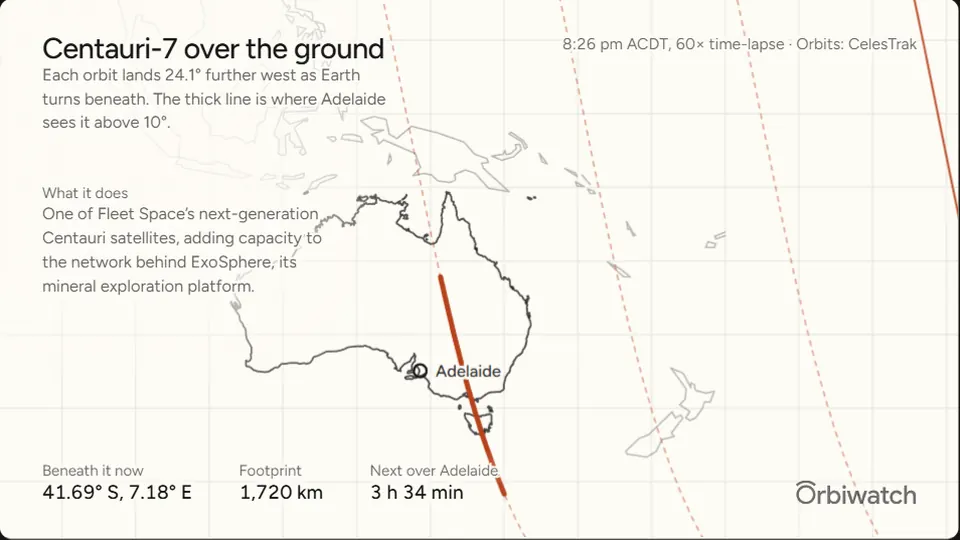
One film, five places to show it. On a wide screen the device beside the steps plays the real player for the place and satellite you picked above; only the device around it is drawn.

  1. The live player on a company’s mission page, Kanyini over Lot Fourteen

    A live satellite tracker for an Australian mission page

    Your satellite over your site on your mission page, locked to your domain. It works itself out again every time it loads.

    WhoSpace companies and agencies

    WhenMission pages, investor updates

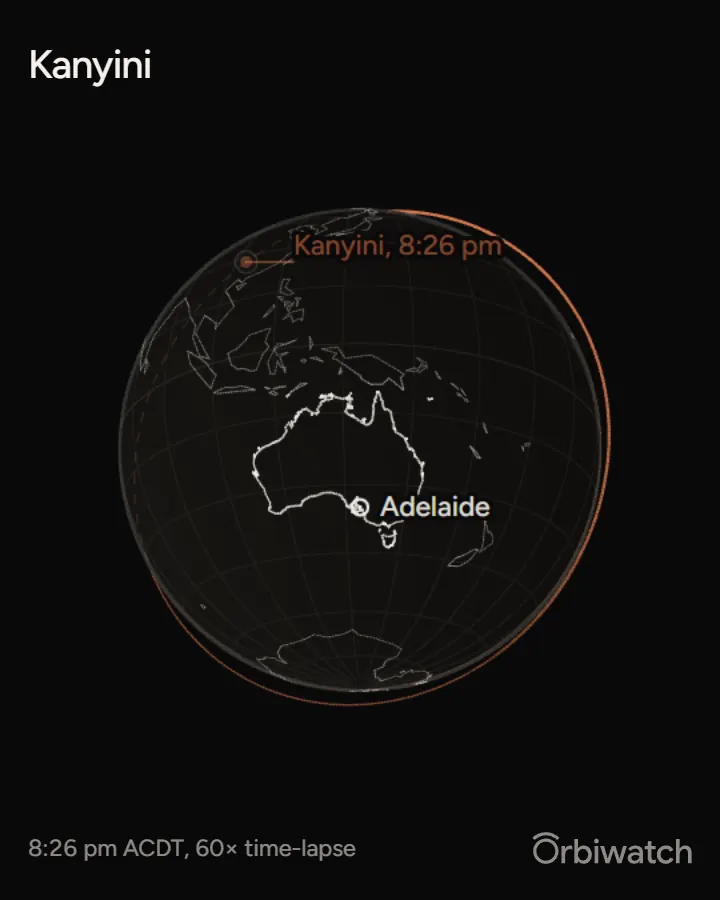
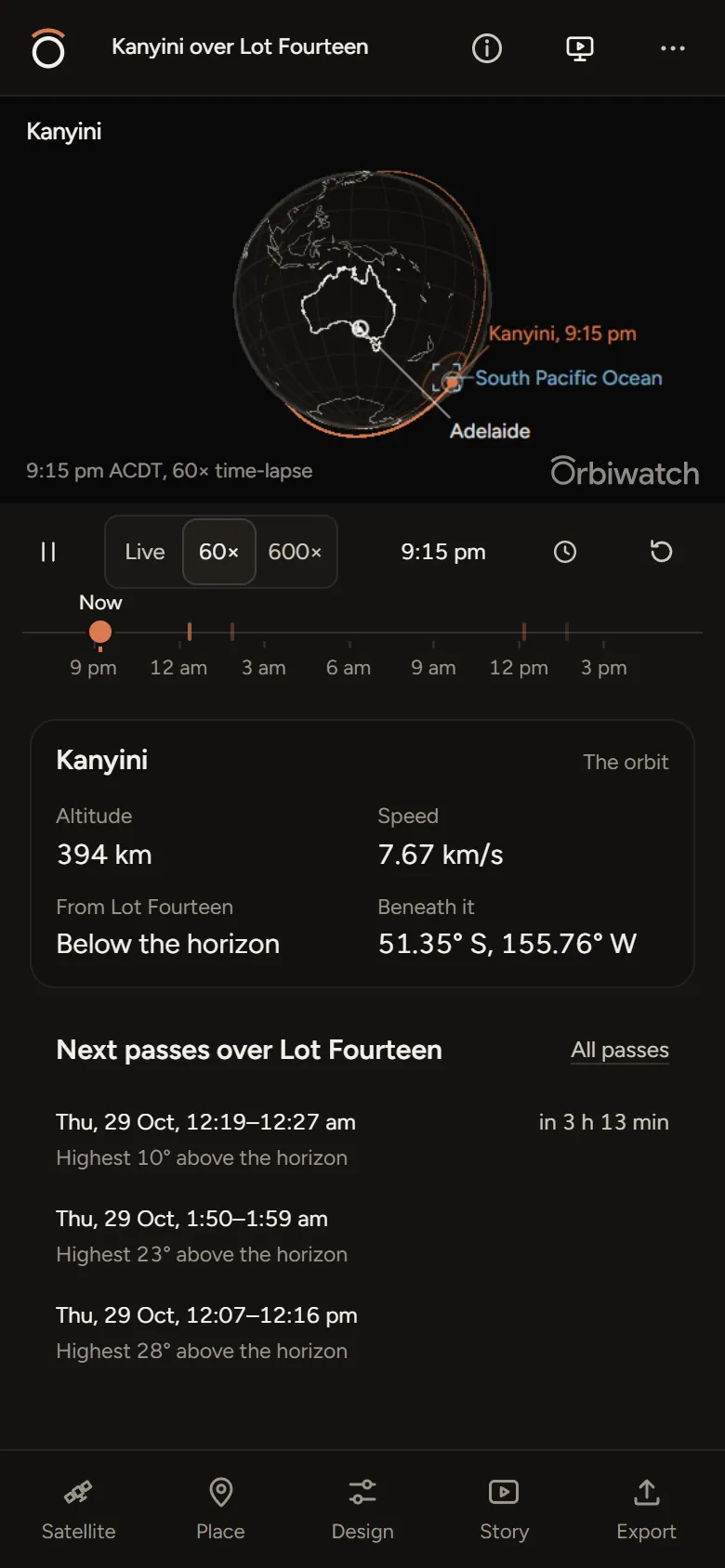
  2. The same player on a phone

    Launch films for Australian launch operators

    A launch-week page and a pad-side screen with the orbit you are aiming for, computed from real elements.

    WhoLaunch operators and their payload customers

    WhenLaunch week

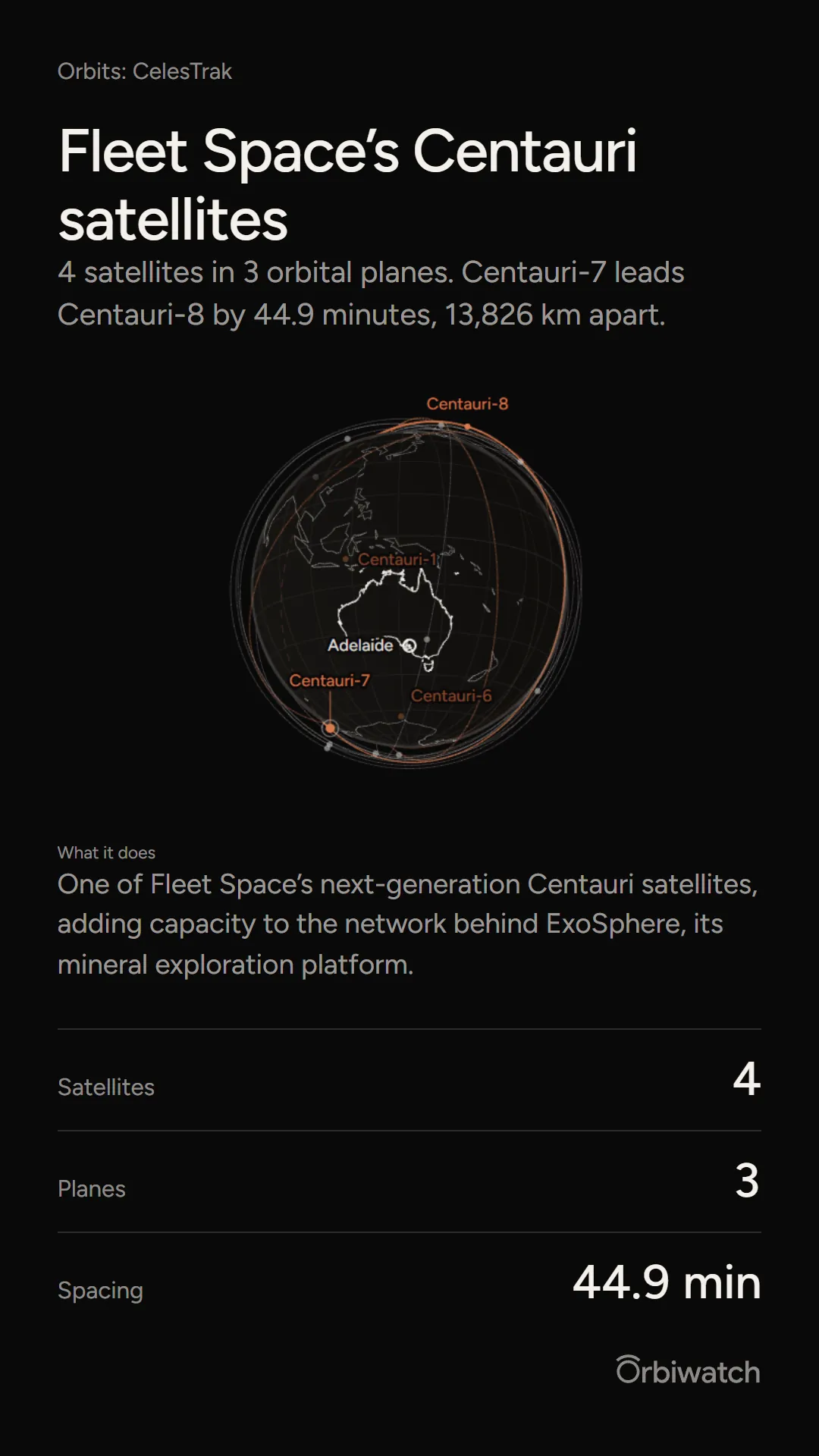
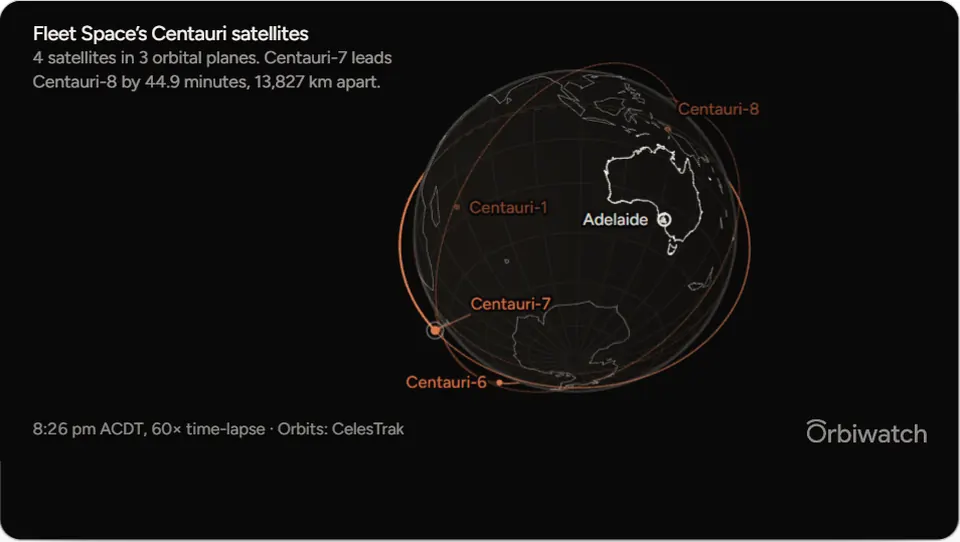
  3. Display mode on a portrait kiosk, Fleet Space’s Centauri satellites

    Satellite films for agencies and space precincts

    A lobby screen that shows what is overhead right now, for every visitor and delegation.

    WhoPrecincts, visitor centres, ground stations

    WhenAll day, unattended, for weeks

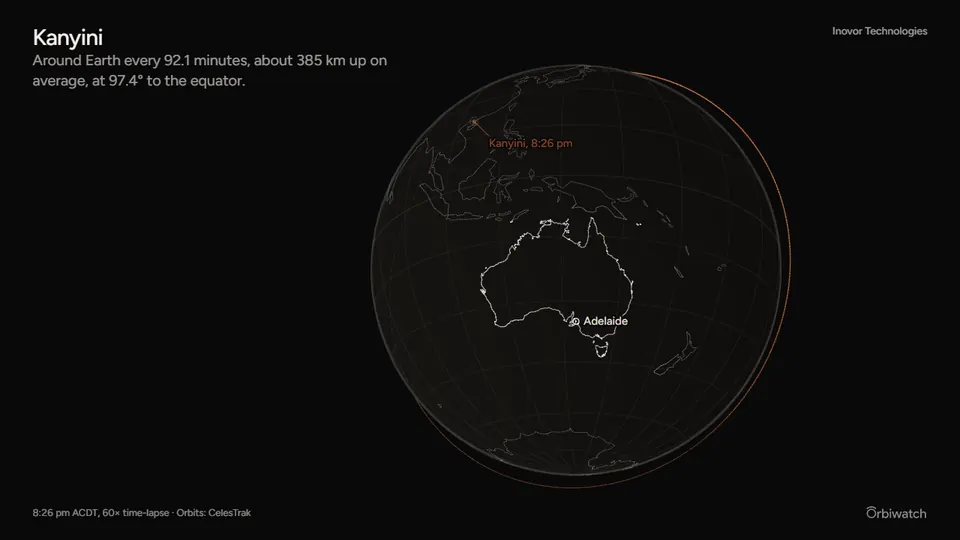
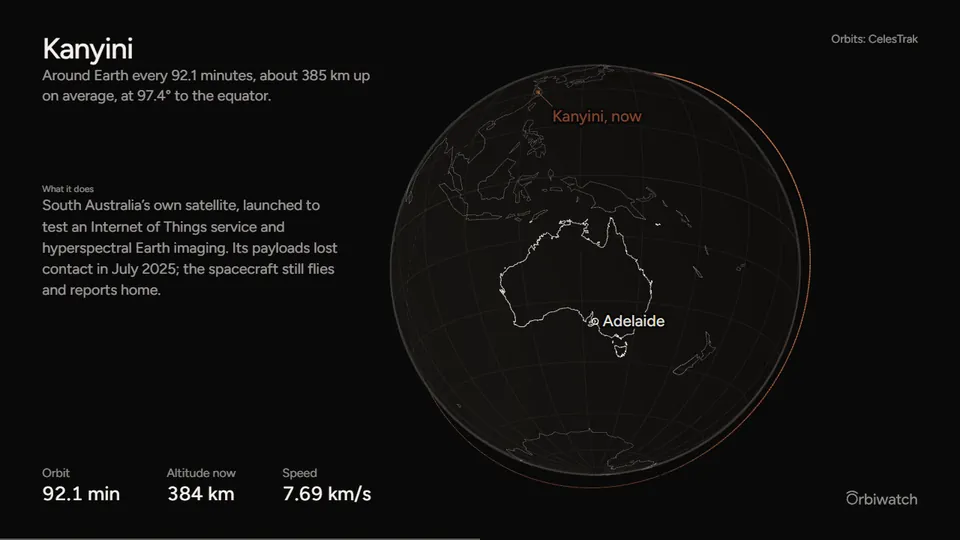
  4. Presenter mode with Kanyini over Adelaide

    An orbit film for a pitch to investors or government

    Your satellite over your site, full screen, stepped through with a clicker. The numbers are computed the morning you present.

    WhoFounders and mission leads

    WhenRaises, board meetings, Canberra briefings

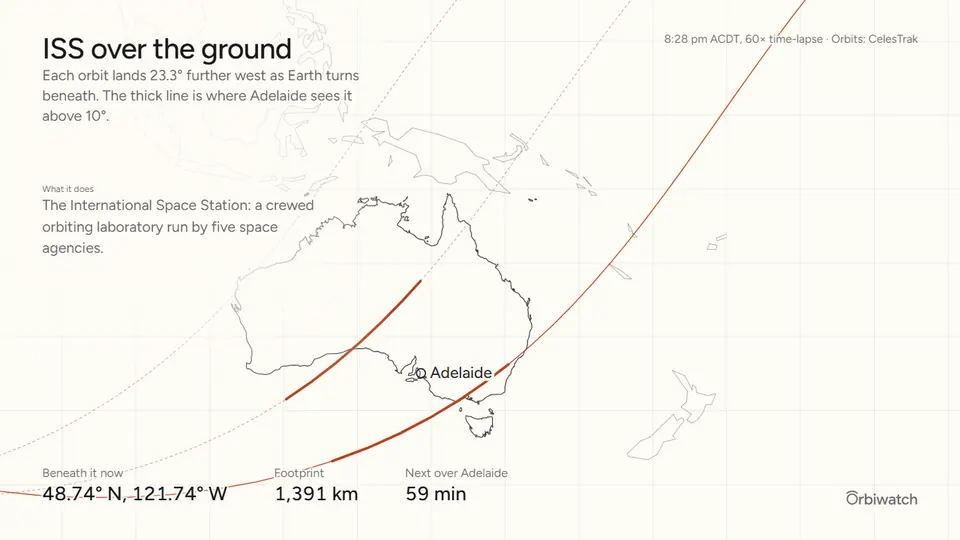
  5. Display mode on a 16:9 screen with the ISS

    Satellite passes for schools and universities

    The ground track on the classroom screen, with the next pass over your campus counted down: when to go outside and where to look.

    WhoSchools and universities

    WhenClass before tonight’s pass

Satellites over Australia, computed today.

Every film on this page starts from the satellite’s latest orbital elements from CelesTrak, refreshed every two hours, and works the orbit forward with the standard propagation model.

The passes are worked out for each place’s own latitude and longitude, so the sky chart over Bowen is not the one over Adelaide.

Orbital elements
CelesTrak, refreshed every 2 hours
Passes
Worked out for each place
Accurate for
Presentation, not navigation

Pricing for live satellite films.

Each plan below is playing its own film: the real player, computed from today’s orbital elements.

Living Film

A live satellite film for your website

US$200per film, per monthA$290per film, per month, ex GST€180per film, per month¥32,000per film, per monthCN¥1,350per film, per month

A mission page that stays true: your satellite, live on your site, and MP4s whenever you need a file.

  • Your satellite, site and brand, recomputed daily
  • A live embed locked to your domain
  • 1080p MP4 exports from our film pipeline
  • Cancel any month

Kanyini over Lot Fourteen, as it plays on a mission page. Drag the globe.

Display

A satellite display for a lobby or event

US$410per screen, per monthA$590per screen, per month, ex GST€370per screen, per month¥65,000per screen, per monthCN¥2,750per screen, per month

A lobby TV, kiosk or event screen that runs on its own for weeks.

  • Display mode, set up with one link
  • Your satellites and site, rotating through every story
  • Layouts for portrait, 16:9, 21:9, 4:3 and square
  • Presenter mode for pitches and briefings

Kanyini over Lot Fourteen on a 16:9 lobby screen, in display mode.

Mission Film commission

A custom satellite launch film

US$4,800fromA$6,900from, ex GST€4,300from¥760,000fromCN¥32,000from

A custom film of your hardware and mission, cut for the launch video, the deck and the socials.

  • Designed by Vlad Kutepov: storyboard, scenes and edits made with you
  • Built on the same live engine
  • Every export the Living Film includes
  • A 25% deposit of US$1,200 books the workA 25% deposit of A$1,725 books the workA 25% deposit of €1,075 books the workA 25% deposit of ¥190,000 books the workA 25% deposit of CN¥8,000 books the work

A film cut: this page’s satellites as a constellation, framed like the export.

Prices are in US dollars, and checkout charges the price shown.Prices are in Australian dollars and exclude GST.Prices are in euros, and checkout charges the price shown.Prices are in Japanese yen, and checkout charges the price shown.Prices are in Chinese yuan, and checkout charges the price shown.

Make your film in the studio.

Pick a satellite and a place, and the film is computed live. Export it as an MP4, or put it on your own screen.

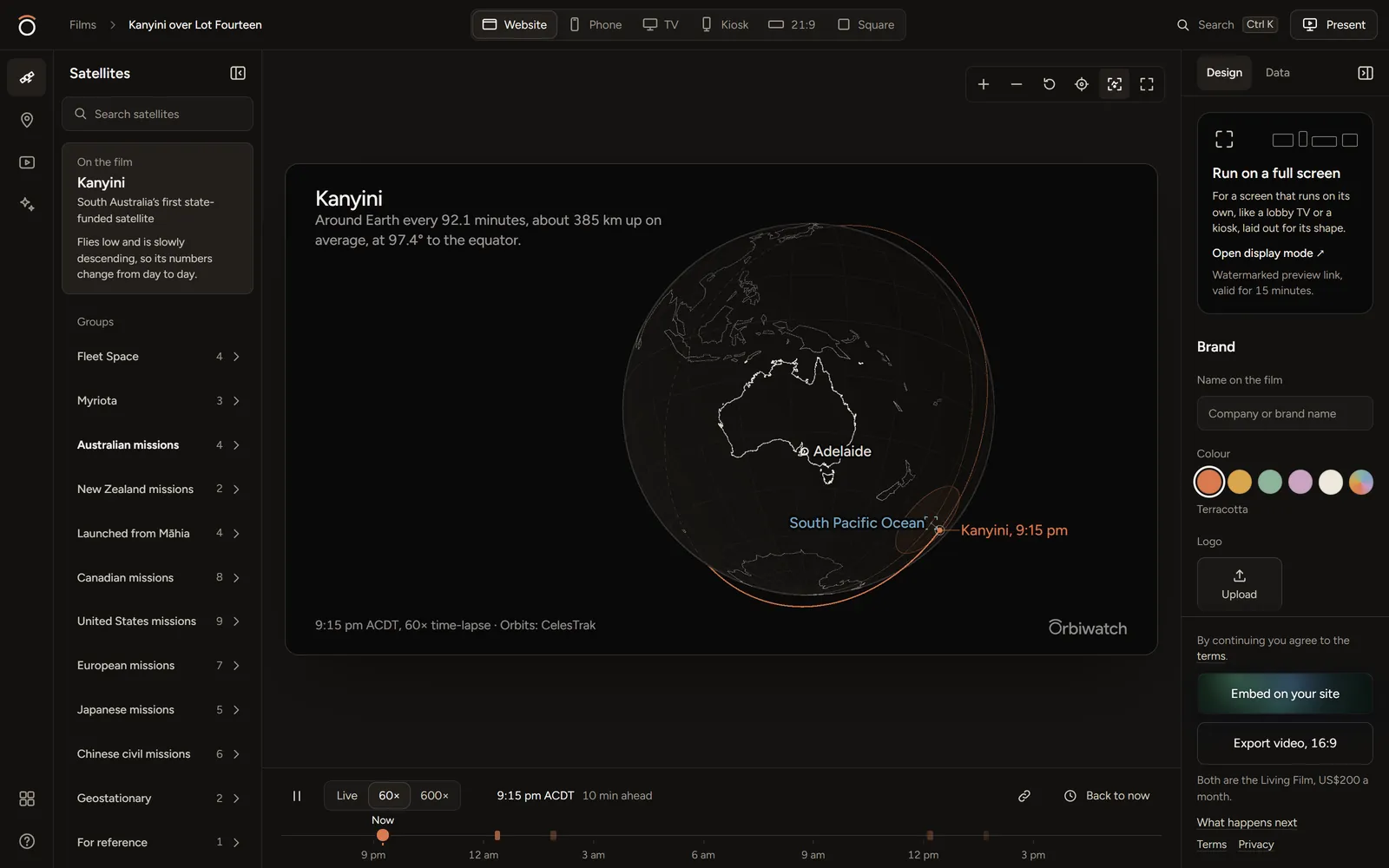
The Orbiwatch studio on a desktop: the satellite list, the live Kanyini film and the design panel
The studio on a phone: the live film above Kanyini’s numbers, with the bar for satellite, place, design, story and export