Live satellites over China’s launch sites.

Each site below is paired with a civil satellite that launched from it or a mission it serves. Pick a site to see that satellite on the globe and its next pass, in Beijing time.


Next over Wenchang: Computing… · Tiangong

Computed from today’s orbital elements from CelesTrak. Drag the globe, scroll or pinch to zoom.

Place

Satellite

More satellites

View

About Tiangong

China’s space station, three modules run by the China Manned Space Agency.

  • Its core module, Tianhe, launched from Wenchang on a Long March 5B on 29 April 2021.
  • Completed in November 2022, when the third module, Mengtian, was in place.
  • Three crew live aboard, six during a handover.

Nearest the equator

Wenchang, China’s launch site on Hainan island

At 19° north, Wenchang is the Chinese launch site nearest the equator. Its first rocket, a Long March 7, flew in 2016.

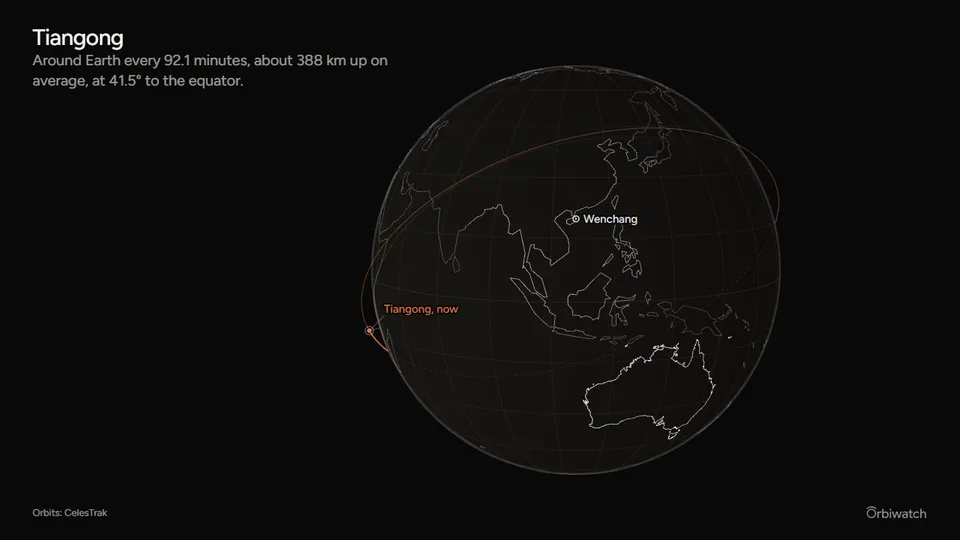
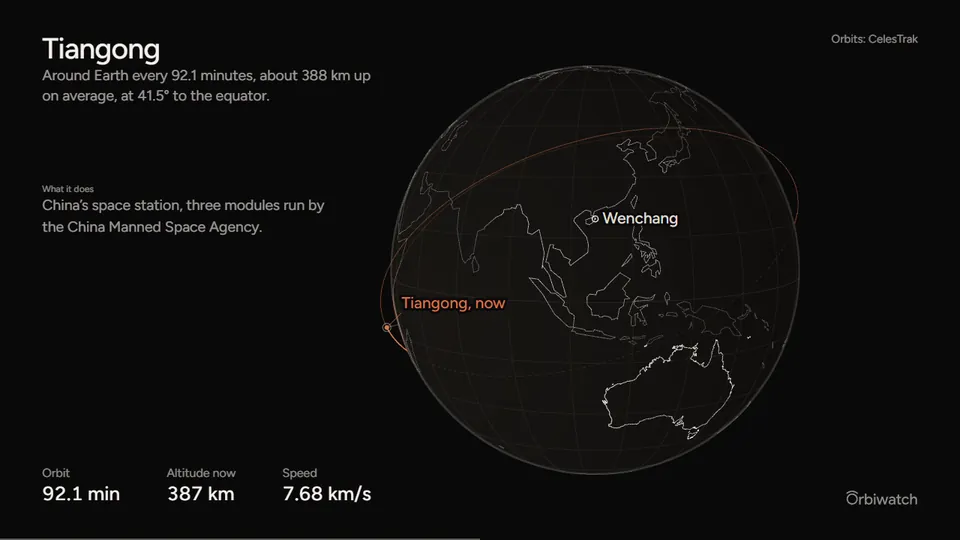
All three modules of the Tiangong space station launched from here on Long March 5B rockets, between April 2021 and October 2022. The globe shows the station’s orbit, tilted 41.5° to the equator.

First launch
2016, Long March 7
Latitude
19.6° N
Shown
Tiangong, orbit

Civil satellites over five Chinese space sites.

Wenchang, Hainan. First launch: 2016, Long March 7.

  • Tianwen-1, China’s first Mars landing mission, launched here on a Long March 5 on 23 July 2020.
  • Chang’e 6 launched here on 3 May 2024 and returned 1,935.3 g from the Moon’s far side.

Sources: spaceflightnow.com, ydyl.gansu.gov.cn, en.wikipedia.org

Jiuquan, China’s oldest launch site

40.9581° N, 100.2911° E

Ejin Banner and Jinta County. Founded: 1958.

  • Yang Liwei flew Shenzhou 5, China’s first crewed mission, from here on 15 October 2003.
  • The centre covers about 2,800 km².

Sources: en.wikipedia.org

Mianning County, Sichuan. In service since: 1984.

  • Chang’e 4 left here on 8 December 2018 and landed on the Moon’s far side on 3 January 2019.
  • The final BeiDou-3 satellite launched here on 23 June 2020, completing the constellation.
  • Xichang’s first launch, a Long March 3, flew on 29 January 1984.

Sources: xinhuanet.com, cnsa.gov.cn, spaceflightnow.com, en.wikipedia.org

Kelan County, Shanxi. Founded: 1966.

  • Taiyuan came into full operation in 1968, two years after its founding.
  • Brazil’s INPE supplied two of CBERS-4A’s three Earth-imaging instruments.
  • CBERS-4A flies in a polar sun-synchronous orbit about 620 km up.

Sources: en.wikipedia.org, spaceflightnow.com

Science and Technology Museum. Opened: September 2009.

  • 1,420 students joined the first Tiangong lesson from five classrooms across China.
  • Shenzhou 13 astronauts Zhai Zhigang, Wang Yaping and Ye Guangfu taught the lesson.
  • The museum was founded in 1988; its new building has about 48,000 m² of floor space.

Sources: news.cgtn.com, govt.chinadaily.com.cn, en.wikipedia.org

Live films of China’s civil satellites, for every screen.

A partner agency’s website, a phone, a museum hall, a classroom and a briefing room can all run the same computed film. Wide screens show it in the device beside the steps, set to your site and satellite.

  1. The live player on a mission page, Tiangong over Wenchang

    A live satellite tracker for a joint mission’s website

    Put a shared satellite such as SVOM or CBERS-4A on your own site, its position recomputed whenever the page loads.

    WhoPartner agencies, research institutes, universities

    WhenLaunch anniversaries, data releases, conferences

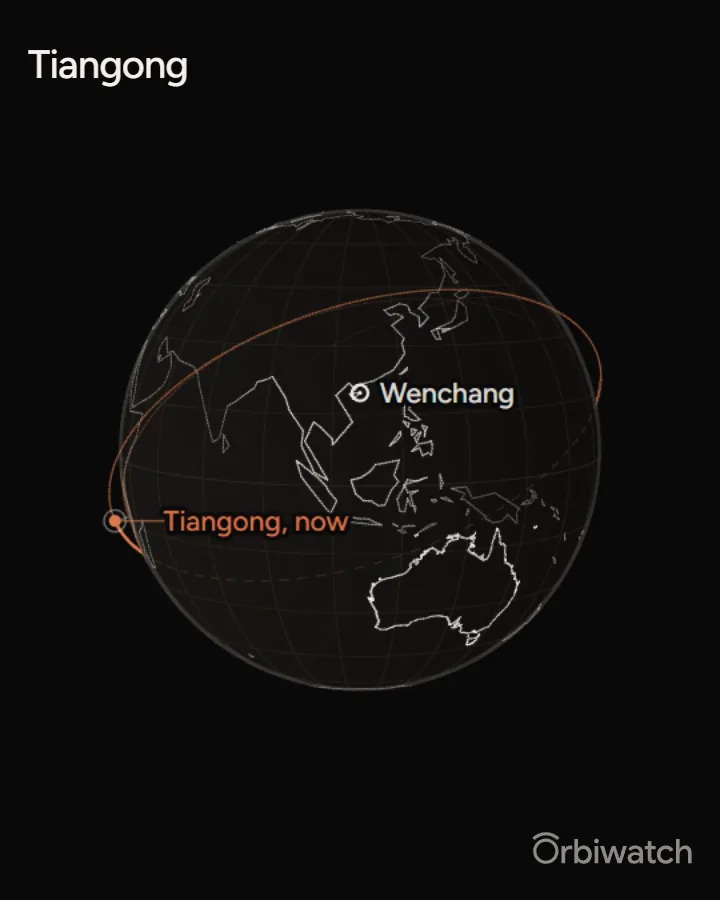
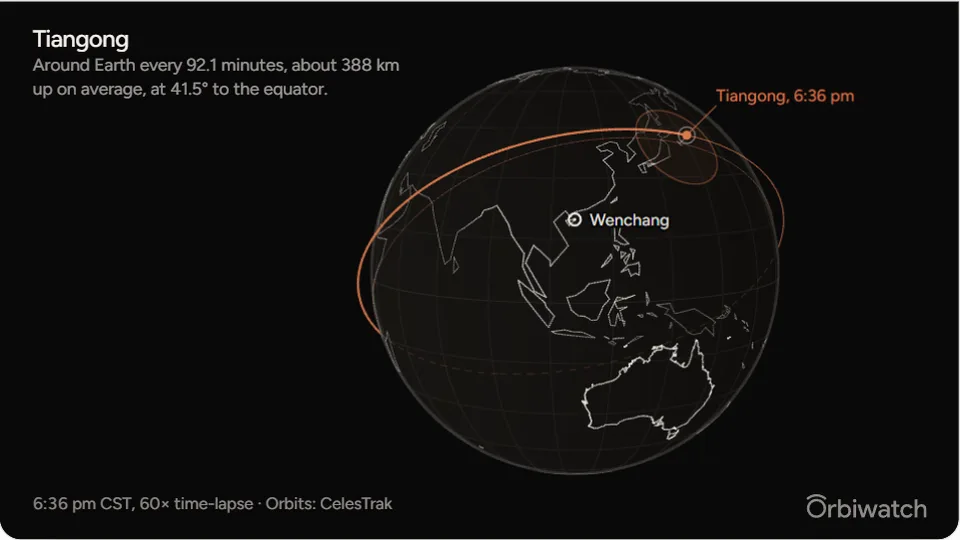
  2. The same player on a phone, Tiangong over Wenchang

    Tiangong on any phone

    One link opens the space station on a phone and counts down to its next pass over the site you chose.

    WhoVisitors, students, science journalists

    WhenCrew launch and return days

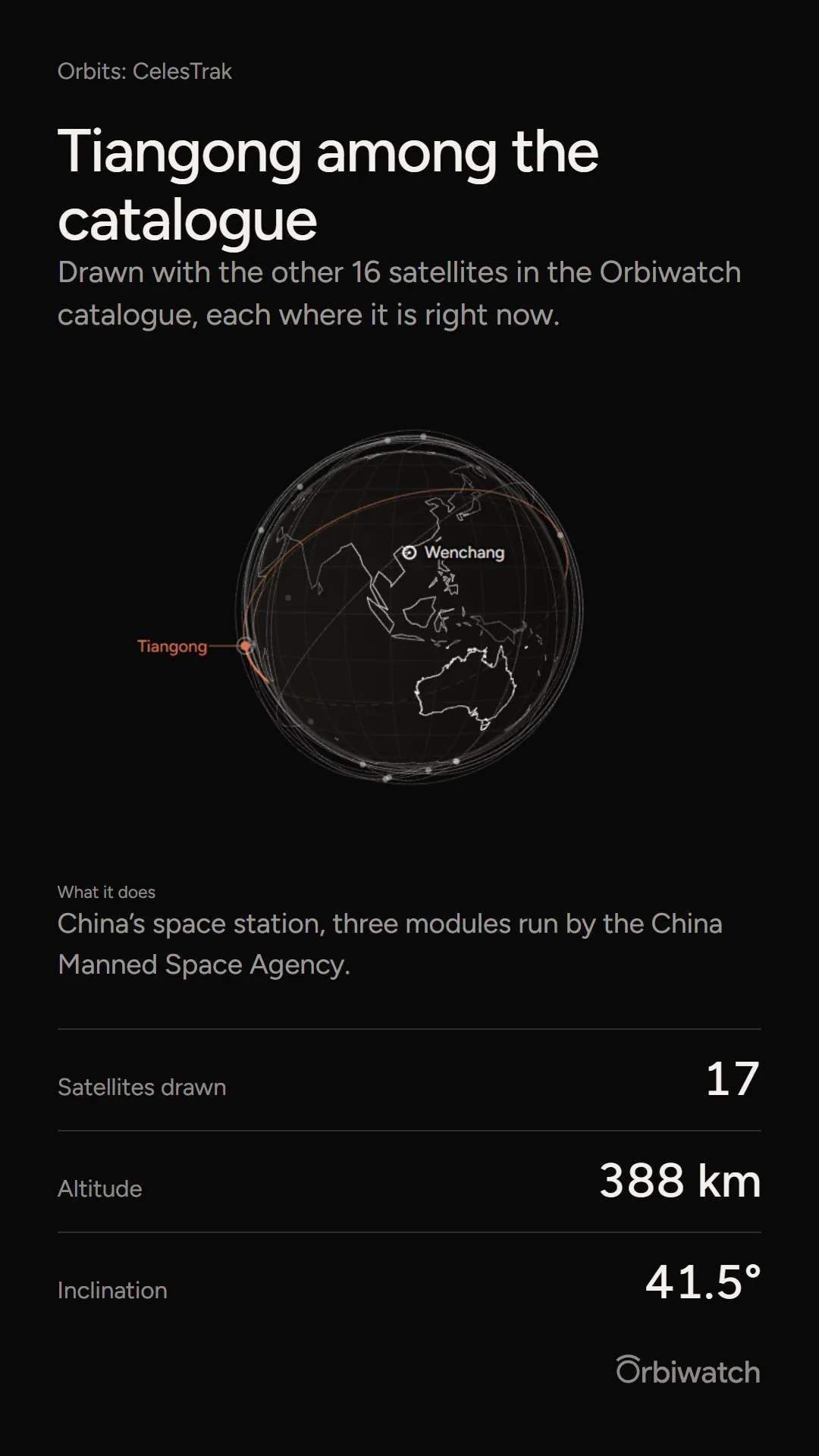
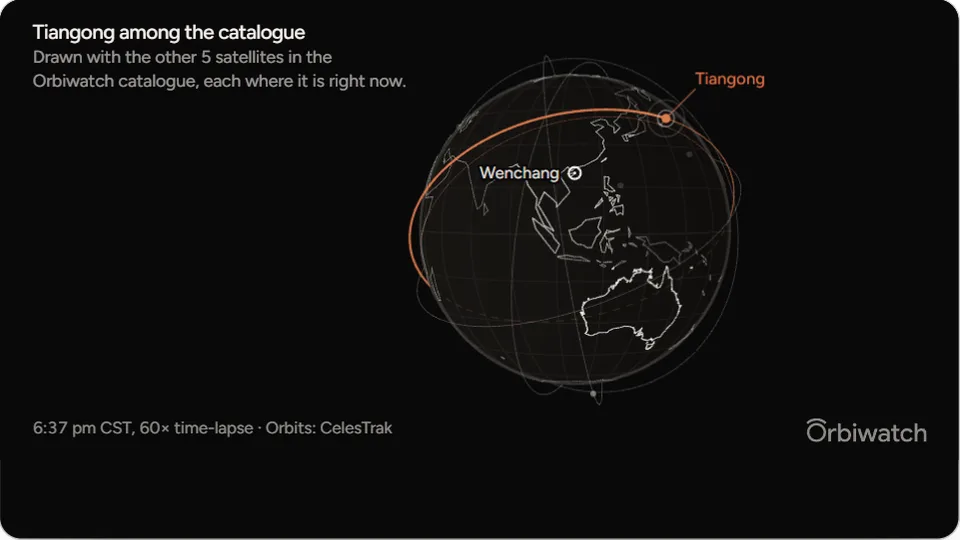
  3. Display mode on a portrait screen, Tiangong drawn with the other satellites Orbiwatch tracks

    A live satellite wall for a science museum

    A tall screen with the space station and more than a dozen other satellites on the globe, each one where it is right now.

    WhoScience museums and planetariums

    WhenAll day, unattended

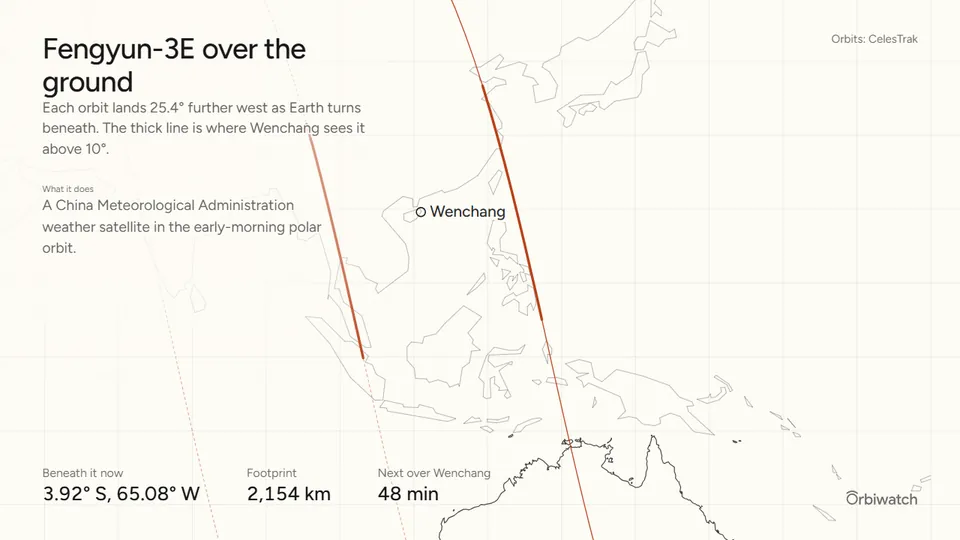
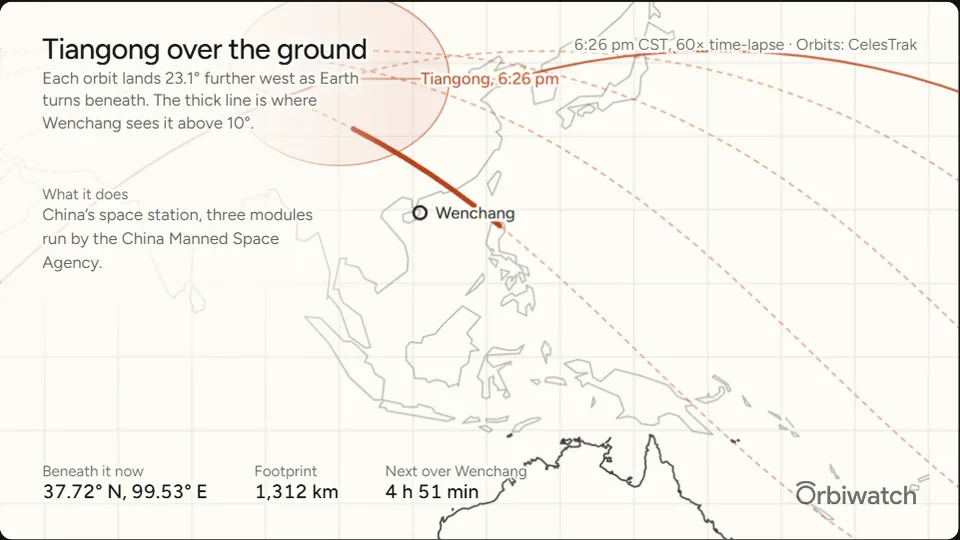
  4. Display mode on a 16:9 screen, Fengyun-3E’s ground track past Wenchang

    Weather satellite passes for classrooms

    Follow a weather satellite’s path as it runs north to south across China, then count down to its next pass over the school.

    WhoSecondary schools and science museums

    WhenA geography or science lesson

  5. Presenter mode with Tiangong over Wenchang

    A satellite orbit film for a partner briefing

    Only the film on screen, a clicker to move through it, and figures computed on the day.

    WhoMission teams and international partners

    WhenJoint reviews, conferences, briefings

China’s civil satellites, computed today.

Each satellite’s orbit comes from the elements CelesTrak publishes, which we fetch every two hours and propagate forward.

China keeps one time zone, so every pass on this page reads in Beijing time, from Wenchang in the south to Jiuquan in the north-west.

Orbital elements
CelesTrak, every 2 hours
Times
Beijing time, UTC+8
Satellites
Civil missions only

Pricing for live satellite films.

Each plan below is playing its own film: the real player, computed from today’s orbital elements.

Living Film

A live satellite film for your website

US$200per film, per monthA$290per film, per month, ex GST€180per film, per month¥32,000per film, per monthCN¥1,350per film, per month

A mission page that stays true: your satellite, live on your site, and MP4s whenever you need a file.

  • Your satellite, site and brand, recomputed daily
  • A live embed locked to your domain
  • 1080p MP4 exports from our film pipeline
  • Cancel any month

Tiangong over Wenchang, as it plays on a mission page. Drag the globe.

Display

A satellite display for a lobby or event

US$410per screen, per monthA$590per screen, per month, ex GST€370per screen, per month¥65,000per screen, per monthCN¥2,750per screen, per month

A lobby TV, kiosk or event screen that runs on its own for weeks.

  • Display mode, set up with one link
  • Your satellites and site, rotating through every story
  • Layouts for portrait, 16:9, 21:9, 4:3 and square
  • Presenter mode for pitches and briefings

Tiangong over Wenchang on a 16:9 lobby screen, in display mode.

Mission Film commission

A custom satellite launch film

US$4,800fromA$6,900from, ex GST€4,300from¥760,000fromCN¥32,000from

A custom film of your hardware and mission, cut for the launch video, the deck and the socials.

  • Designed by Vlad Kutepov: storyboard, scenes and edits made with you
  • Built on the same live engine
  • Every export the Living Film includes
  • A 25% deposit of US$1,200 books the workA 25% deposit of A$1,725 books the workA 25% deposit of €1,075 books the workA 25% deposit of ¥190,000 books the workA 25% deposit of CN¥8,000 books the work

A film cut: this page’s satellites as a constellation, framed like the export.

Prices are in US dollars, and checkout charges the price shown.Prices are in Australian dollars and exclude GST.Prices are in euros, and checkout charges the price shown.Prices are in Japanese yen, and checkout charges the price shown.Prices are in Chinese yuan, and checkout charges the price shown.

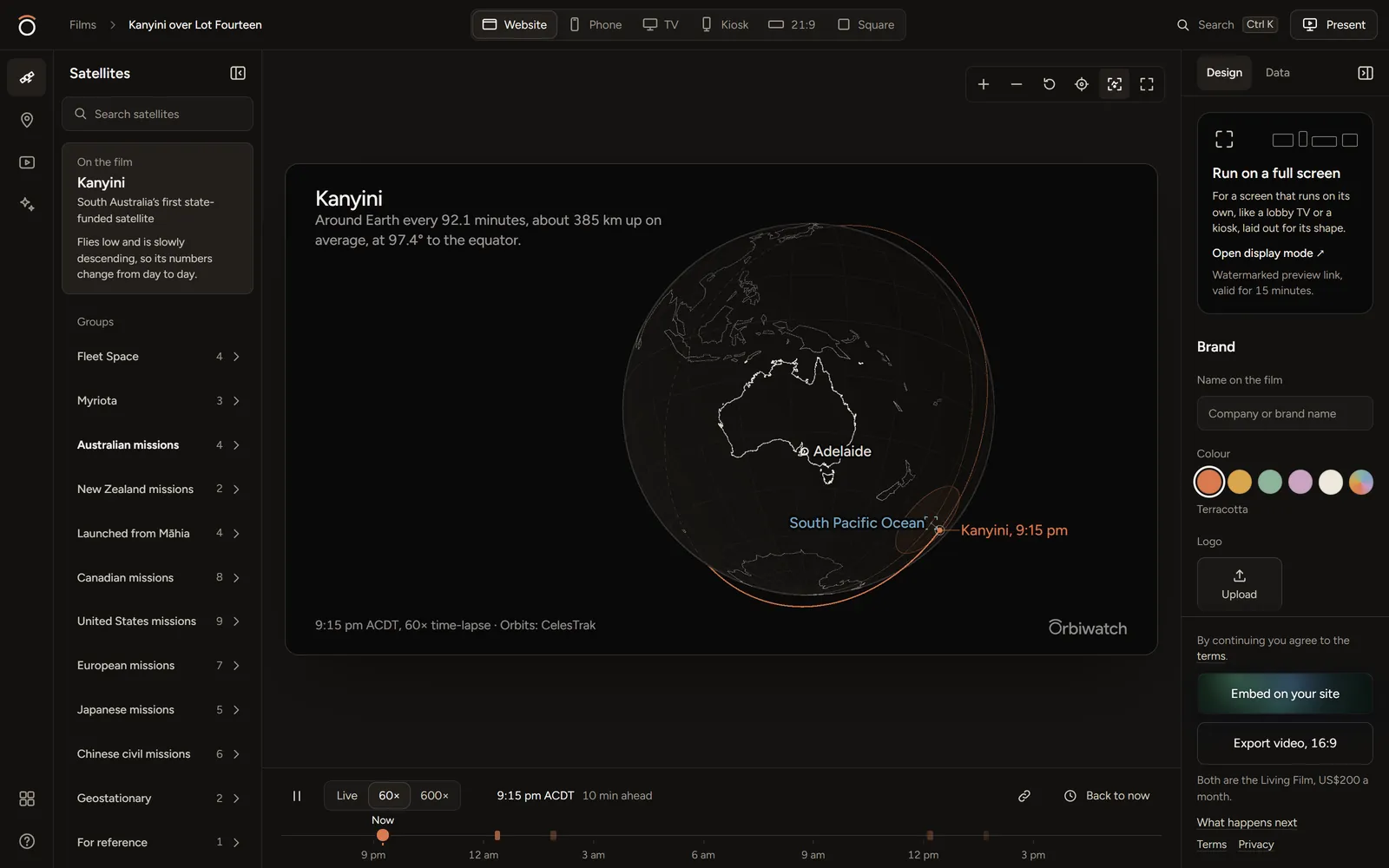
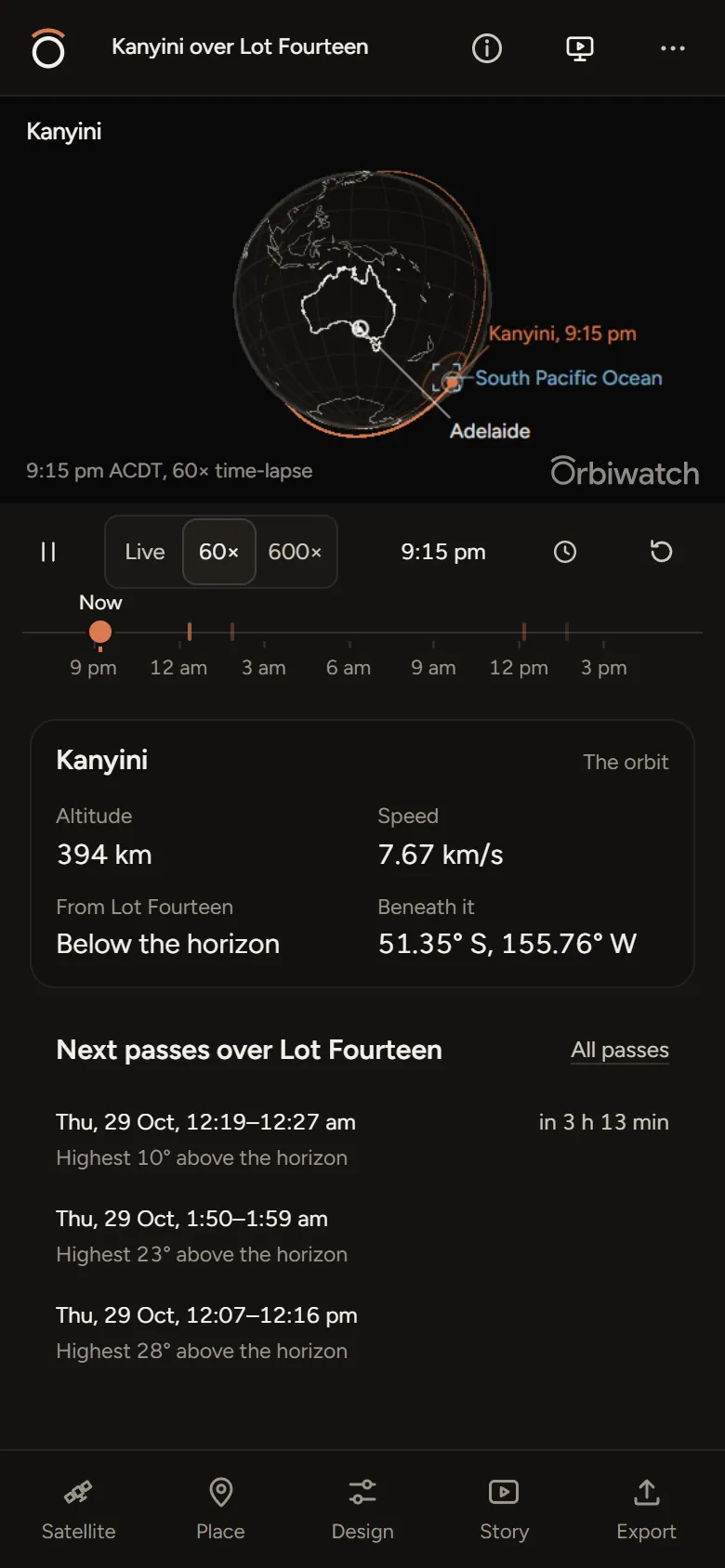
Make your film in the studio.

Pick a satellite and a place, and the film is computed live. Export it as an MP4, or put it on your own screen.

The Orbiwatch studio on a desktop: the satellite list, the live Kanyini film and the design panel
The studio on a phone: the live film above Kanyini’s numbers, with the bar for satellite, place, design, story and export