Live satellites over New Zealand’s space sites.

From Rocket Lab’s launch pad on the Māhia Peninsula to a ground station near Invercargill, every place below is a real New Zealand space site. Pick one: the film flies there and works out what passes over it today, in New Zealand time.


Next over Māhia Launch Complex 1: Computing… · Kinéis-1A

Computed from today’s orbital elements from CelesTrak. Drag the globe, scroll or pinch to zoom.

Place

Satellite

More satellites

View

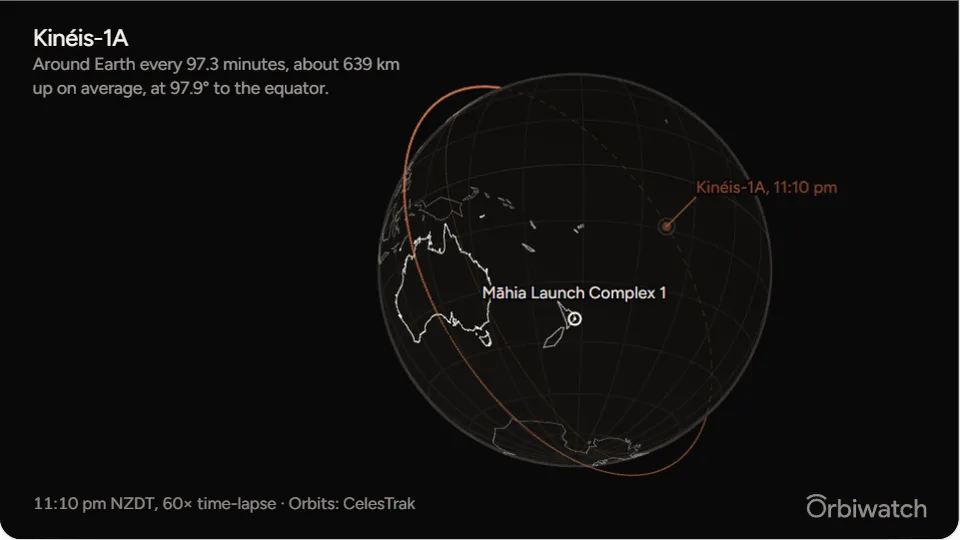
About Kinéis-1A

One of 25 satellites in Kinéis’s Internet of Things network, launched from New Zealand.

  • Rocket Lab launched all 25 Kinéis satellites on five dedicated Electron flights from Māhia.
  • Kinéis grew out of Argos, the satellite location system founded by France’s space agency, CNES.
  • It flies about 630 km up in a near-polar orbit.

The launch pad

Māhia, home of Rocket Lab’s Launch Complex 1

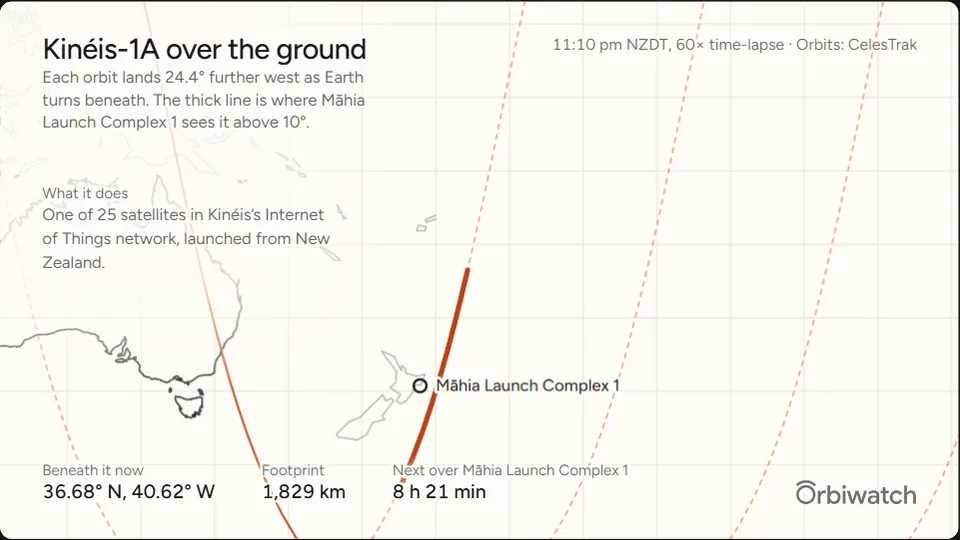
Rocket Lab’s Launch Complex 1 sits near the southern tip of the Māhia Peninsula, on the North Island’s east coast. Its first successful orbital launch, Still Testing, flew on 21 January 2018.

All 25 Kinéis satellites left from here, on five Electron flights. The ground track follows one of them as the Earth turns beneath it.

Operator
Rocket Lab
First orbit
21 January 2018
Shown
Kinéis-1A, ground track

Satellites over five New Zealand space sites.

Māhia Peninsula, Hawke’s Bay. Operator: Rocket Lab.

  • The first Electron launch from here, It’s a Test, reached space on 25 May 2017 but not orbit.
  • The complex has two Electron pads, Launch Complex 1A and 1B.
  • Its licence allowed up to one launch every 72 hours for 30 years.

Sources: en.wikipedia.org

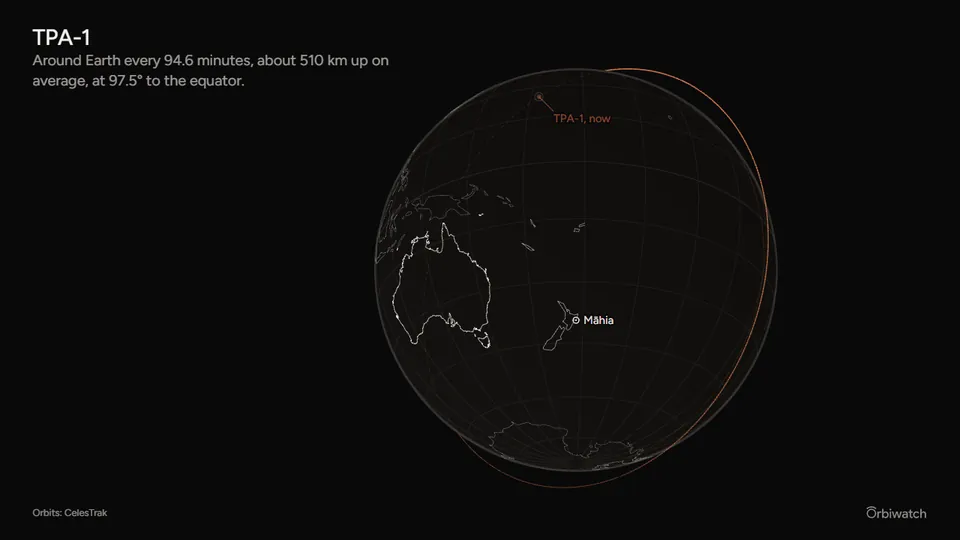
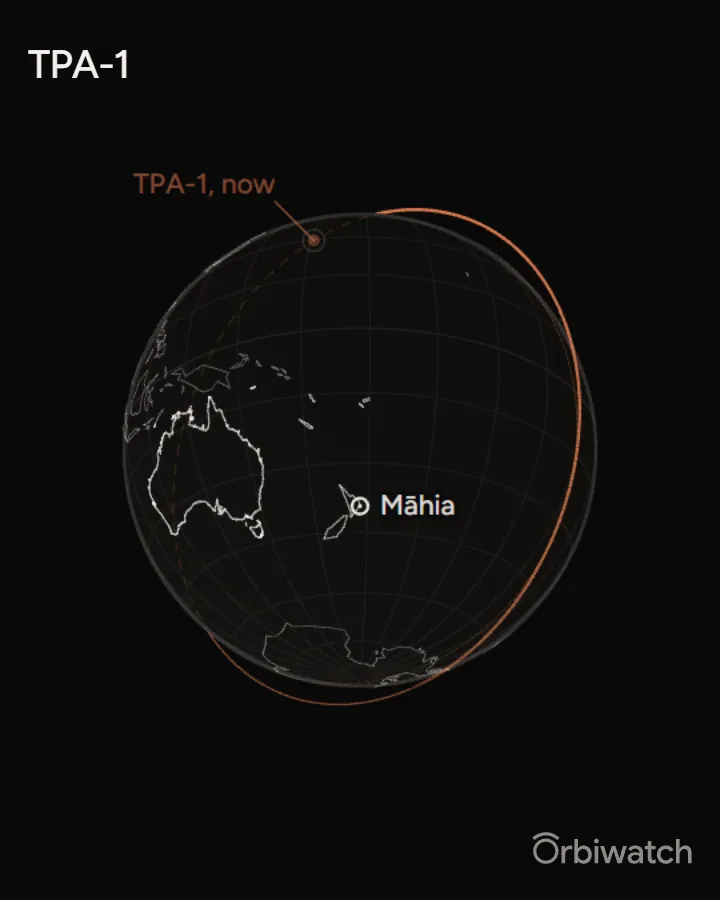
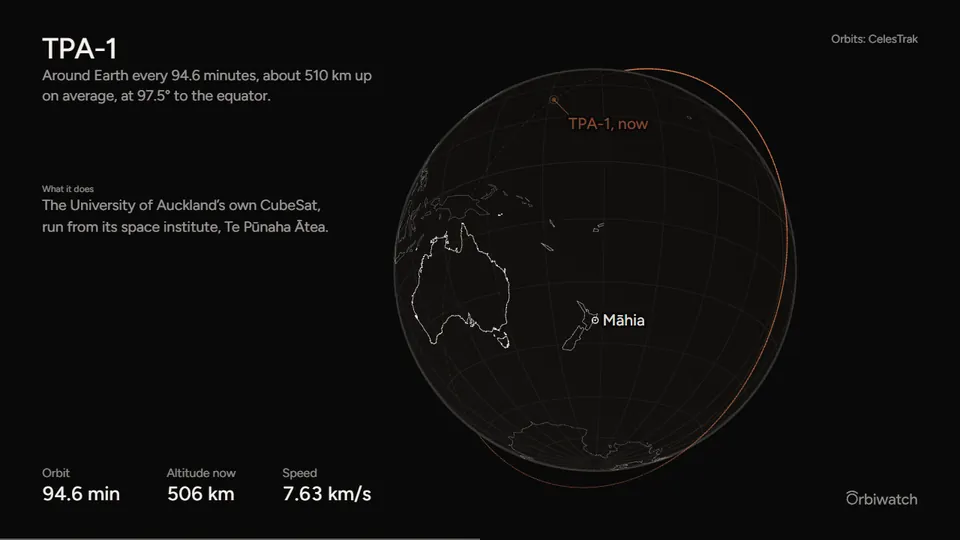
Auckland. Satellite: TPA-1, 3U CubeSat.

  • TPA-1 flies a 505 by 525 km sun-synchronous orbit on a NanoAvionics platform.
  • Its payloads include Earth-observation cameras and a retractable boom for inspecting the spacecraft.
  • TPA-1 began beaconing about two hours after deployment from Transporter-14.

Sources: auckland.ac.nz, space.auckland.ac.nz

Near Invercargill, Southland. Operator: SpaceOps NZ.

  • Commissioned in 2008, the station first tracked ESA’s Jules Verne cargo ship to the ISS.
  • Planet Labs antennas were commissioned here in 2013, the first commercial antennas the site hosted.
  • It is New Zealand’s site for SouthPAN, the Southern Positioning Augmentation Network.

Sources: spaceops.nz, en.wikipedia.org

Takapō, Canterbury. Observatory: University of Canterbury.

  • Founded in 1965, the observatory sits about 1,029 metres above sea level.
  • Its 1.8-metre MOA telescope began microlensing searches for exoplanets in December 2004.
  • The dark sky reserve, designated in June 2012, covers more than 4,300 square kilometres.

Sources: en.wikipedia.org, rnz.co.nz

Kaitorete, Canterbury. Opened: February 2024.

  • Its sealed runway is 1 km long, funded by a NZ$5.4 million government grant.
  • The partnership is buying about 1,000 hectares of Kaitorete Spit between rūnanga-owned land at each end.
  • NASA launched suborbital rockets from Kaitorete in the 1960s.

Sources: odt.co.nz, sciencelearn.org.nz

Satellite films for New Zealand space teams, on every screen.

The same live film on a website, a phone, a lobby screen, a classroom TV and a pitch deck. On a wide screen, the device beside the steps plays the place and satellite you picked above.

  1. The live player on a mission page, TPA-1 over Māhia

    A live satellite tracker for a New Zealand space company

    Your satellite over Aotearoa on your own site, worked out again each time the page loads.

    WhoSpace companies, research institutes, universities

    WhenLaunches, mission updates, funding rounds

  2. The same player on a phone, TPA-1 over Māhia

    Launch-day films from Māhia

    A link your customers open on their phones to follow their satellite from Launch Complex 1 to its first pass over home.

    WhoLaunch customers and their teams

    WhenLaunch day and the weeks after

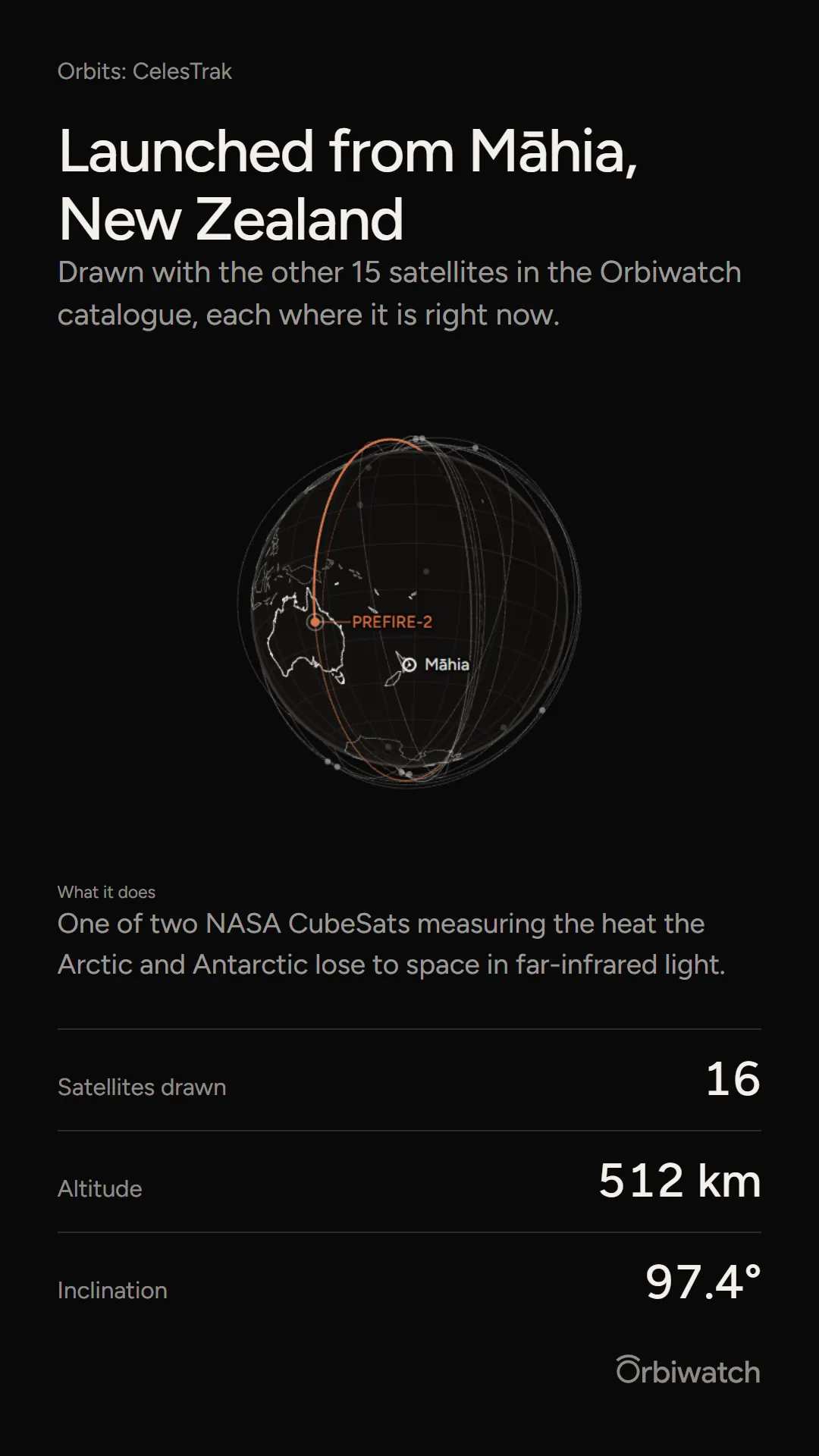
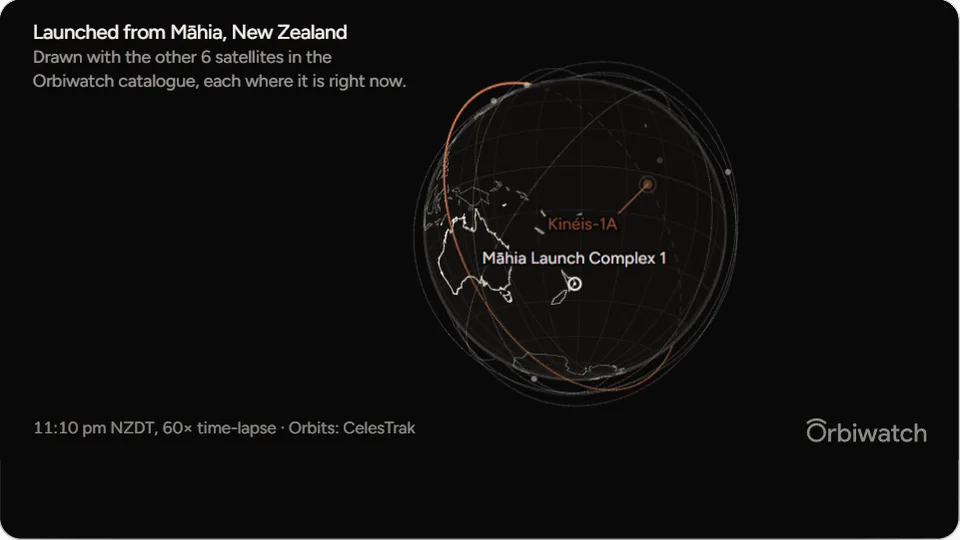
  3. Display mode on a portrait screen, the satellites launched from Māhia

    A satellite display for a visitor centre

    A portrait screen showing which satellites are over New Zealand right now, readable from across the room.

    WhoVisitor centres, observatories, campuses

    WhenAll day, unattended

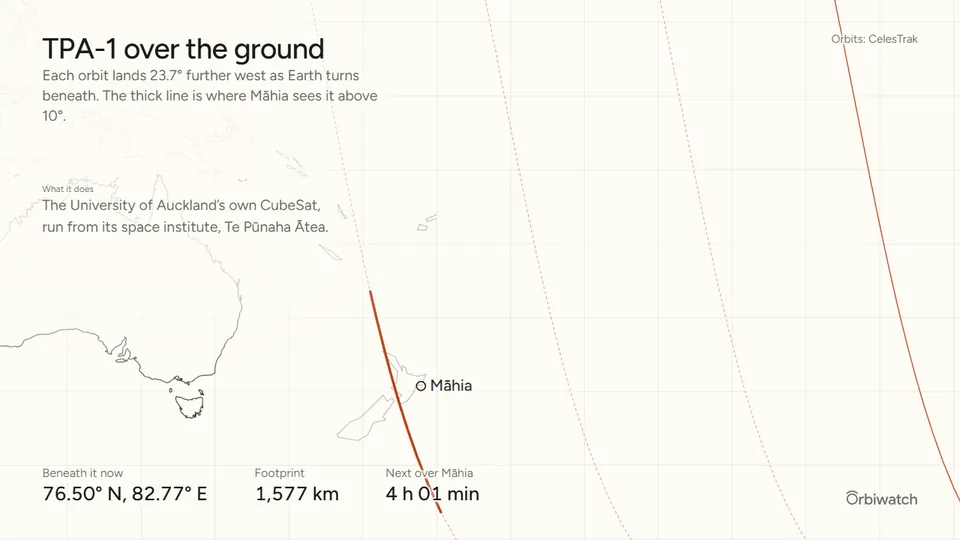
  4. Display mode on a 16:9 screen, TPA-1’s ground track over New Zealand

    Satellite passes for New Zealand classrooms

    The path a student-built satellite takes over the country, and a countdown to its next pass over the school.

    WhoSchools and universities

    WhenA science lesson before tonight’s pass

  5. Presenter mode with TPA-1 over Māhia

    A satellite orbit film for investors and funders

    Full screen, the film only, a clicker to step through it, and every number worked out that morning.

    WhoFounders and mission leads

    WhenRaises, board meetings, agency briefings

Satellites over New Zealand, computed today.

Each film starts from the satellite’s newest orbital elements, published by CelesTrak and fetched every two hours, then works the orbit forward with the standard propagation model.

Passes are worked out for each site’s own latitude and longitude, in New Zealand time, so the sky over Awarua is not the sky over Auckland.

Orbital elements
CelesTrak, every 2 hours
Times
New Zealand time
Accurate for
Presentation, not navigation

Pricing for live satellite films.

Each plan below is playing its own film: the real player, computed from today’s orbital elements.

Living Film

A live satellite film for your website

US$200per film, per monthA$290per film, per month, ex GST€180per film, per month¥32,000per film, per monthCN¥1,350per film, per month

A mission page that stays true: your satellite, live on your site, and MP4s whenever you need a file.

  • Your satellite, site and brand, recomputed daily
  • A live embed locked to your domain
  • 1080p MP4 exports from our film pipeline
  • Cancel any month

Kinéis-1A over Māhia Launch Complex 1, as it plays on a mission page. Drag the globe.

Display

A satellite display for a lobby or event

US$410per screen, per monthA$590per screen, per month, ex GST€370per screen, per month¥65,000per screen, per monthCN¥2,750per screen, per month

A lobby TV, kiosk or event screen that runs on its own for weeks.

  • Display mode, set up with one link
  • Your satellites and site, rotating through every story
  • Layouts for portrait, 16:9, 21:9, 4:3 and square
  • Presenter mode for pitches and briefings

Kinéis-1A over Māhia Launch Complex 1 on a 16:9 lobby screen, in display mode.

Mission Film commission

A custom satellite launch film

US$4,800fromA$6,900from, ex GST€4,300from¥760,000fromCN¥32,000from

A custom film of your hardware and mission, cut for the launch video, the deck and the socials.

  • Designed by Vlad Kutepov: storyboard, scenes and edits made with you
  • Built on the same live engine
  • Every export the Living Film includes
  • A 25% deposit of US$1,200 books the workA 25% deposit of A$1,725 books the workA 25% deposit of €1,075 books the workA 25% deposit of ¥190,000 books the workA 25% deposit of CN¥8,000 books the work

A film cut: this page’s satellites as a constellation, framed like the export.

Prices are in US dollars, and checkout charges the price shown.Prices are in Australian dollars and exclude GST.Prices are in euros, and checkout charges the price shown.Prices are in Japanese yen, and checkout charges the price shown.Prices are in Chinese yuan, and checkout charges the price shown.

Make your film in the studio.

Pick a satellite and a place, and the film is computed live. Export it as an MP4, or put it on your own screen.

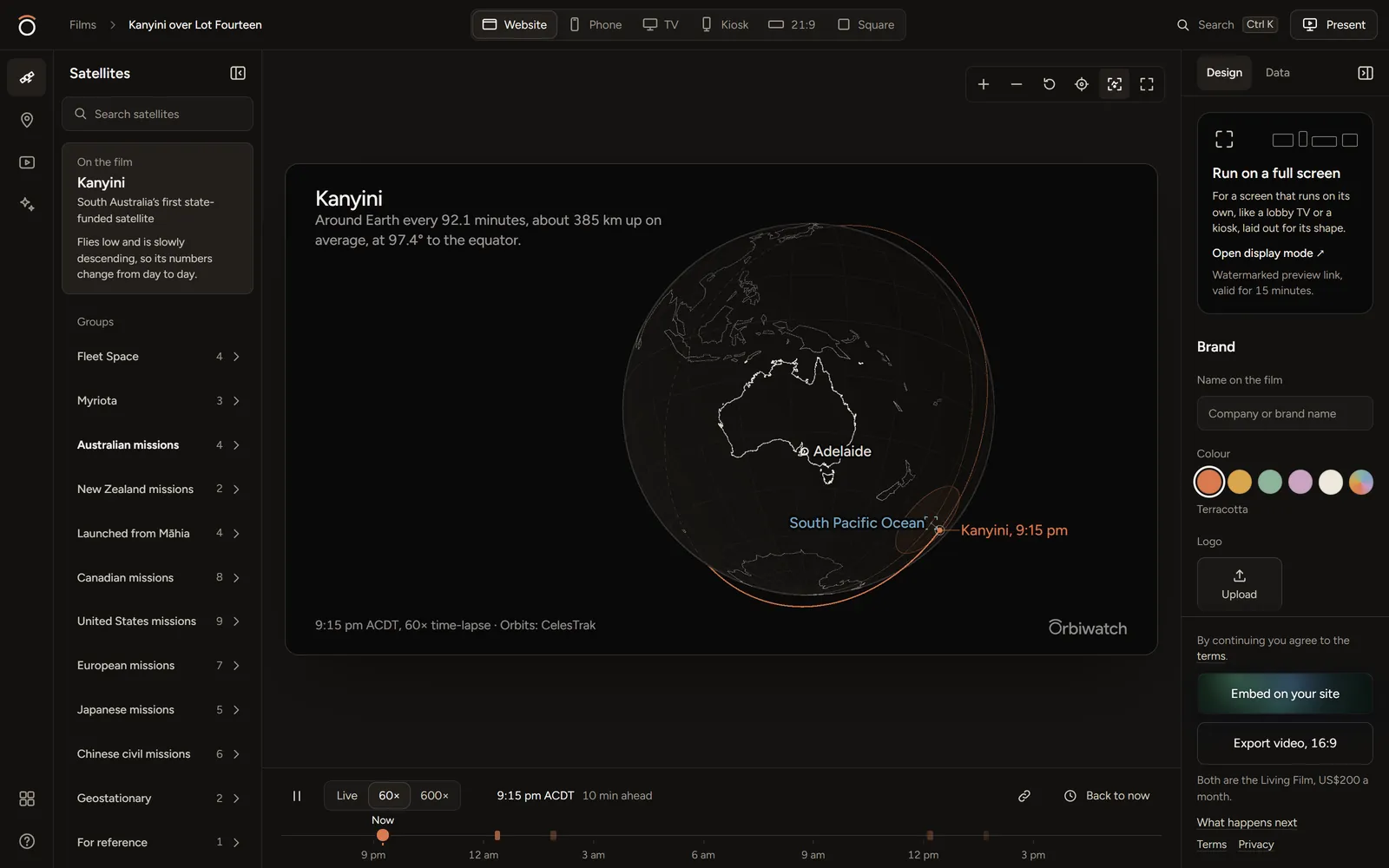
The Orbiwatch studio on a desktop: the satellite list, the live Kanyini film and the design panel
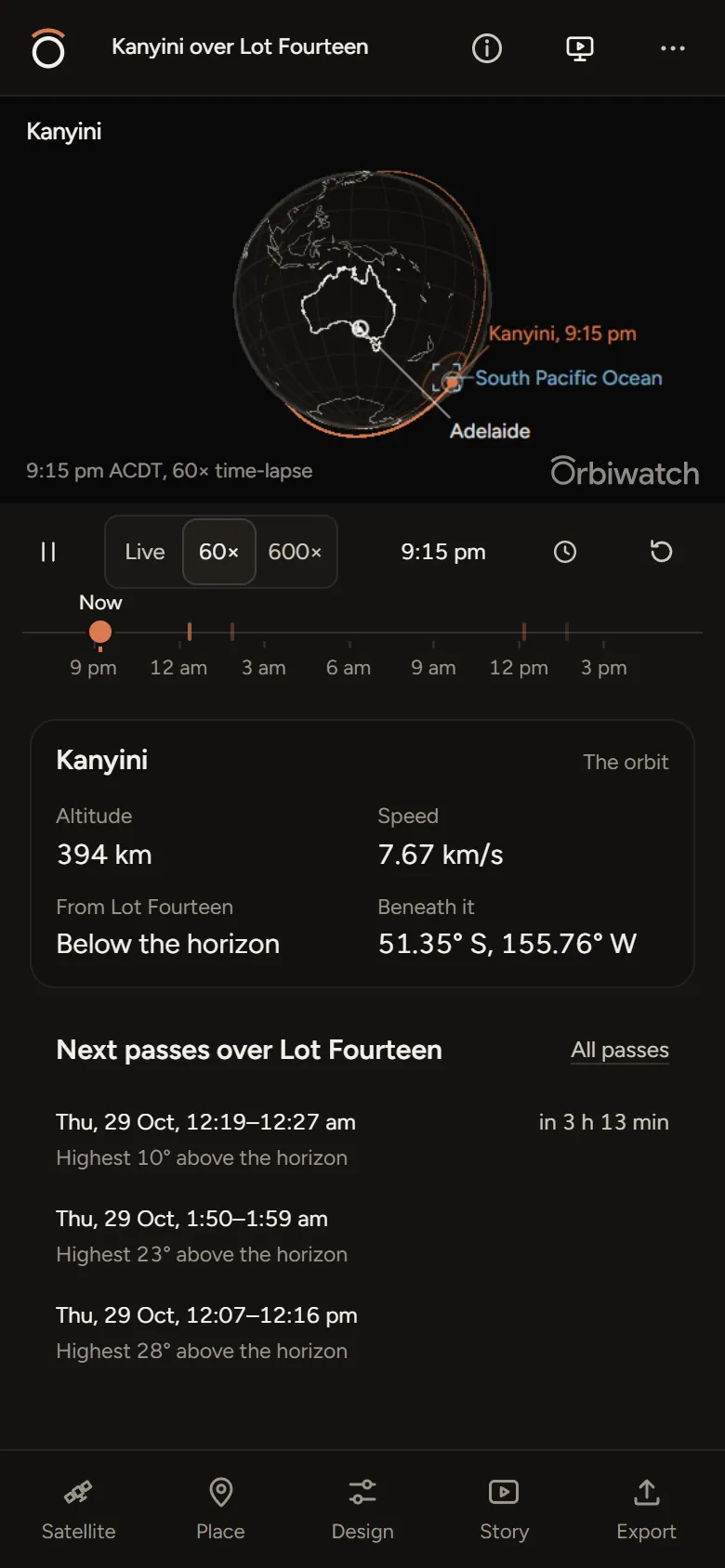
The studio on a phone: the live film above Kanyini’s numbers, with the bar for satellite, place, design, story and export